

Outline for a Multi-Paragraph Response
1. Introductory Paragraph
A. Lead / Hook (from Connect or Get Started)
B. Transition / Bridge (from Summary)
C. Claim (Subject, Opinion, Reason(s))
2. Body Paragraph 1
A. Topic Sentence (Reason 1)
B. Explanation
C. Evidence (textual)
D. Concluding Sentence
3. Body Paragraph 2
A. Topic Sentence (Reason 2)
B. Explanation
C. Evidence (textual or other)
D. Concluding Sentence
4. Concluding Paragraph
A. Counter-Argument Explained
B. Rebuttal (explain why counter-argument is wrong)
C. Concluding Sentence(s)
Another example of a
Multi-Paragraph Argumentative Essay
“Thank You, Ma’am”
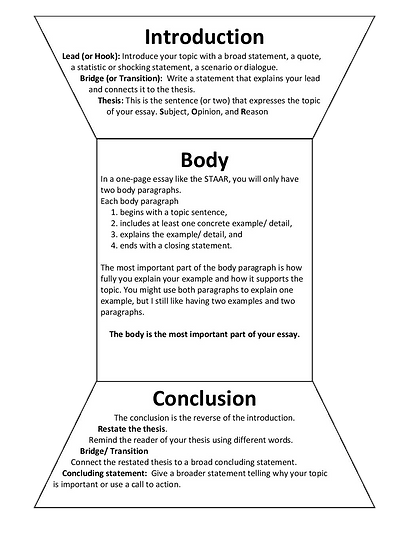
I. The Introductory Paragraph has three parts:
A. Lead / Hook – Begin with a broad idea that introduces the essay’s overall theme.
Example: The mistakes we make in life often help us empathize with others in similar situations.
B. Transition / Bridge – Narrow the focus from the broad opening to the source text and the specific topic of the essay.
Example: In “Thank You, Ma’am,” a woman shows empathy toward a young boy and redirects his path in life.
C. Claim / Thesis – State the central argument you will support with evidence from the text.
Example: Mrs. Jones’s empathy toward Roger will likely have such a positive impact on his life that he turns away from a life of crime.
II. Body Paragraph 1 – Supports the Claim
A. Topic Sentence / Reason – Introduce a reason that supports your claim.
Example: Roger had never had anyone care for him before he met Mrs. Jones.
B. Evidence – Provide textual evidence that supports your topic sentence.
Example: When Mrs. Jones asks Roger, “Ain’t you got nobody home to tell you to wash your face?”, he replies that he doesn’t. Later, he says that there’s “nobody home” at his house to feed him, either.
C. Explanation / Reasoning – Explain how the evidence supports your reason.
Example: With no one at home to feed him or tell him to wash his face, Roger may be experiencing the first act of kindness he has received in a long time.
D. Concluding Sentence – Connect the reason you have explained back to your claim.
Example: Mrs. Jones’s kindness gives Roger a reason to reconsider the choices he has been making.
III. Body Paragraph 2 – Continues to Support the Claim
The second body paragraph follows the same format as the first: topic sentence, evidence, explanation, and concluding sentence. So far, we have shown that Mrs. Jones cares for Roger. Now we need evidence that her kindness is beginning to change his behavior.
Example: Roger’s thoughts during the second part of the story suggest that he will change his ways. When they reach her room, Mrs. Jones leaves the door open, giving Roger an opportunity to escape. Instead, he “looked at the woman—looked at the door—and went to the sink” to wash his face. The story also says that Roger “did not want to be mistrusted now.” Both instances suggest that Roger is already turning over a new leaf. He wants to do the right thing. Mrs. Jones’s kindness has already begun to change Roger by making him want to earn her trust.
IV. Counterargument and Rebuttal
A counterargument presents a reasonable opposing viewpoint. A rebuttal responds to that viewpoint with evidence and reasoning that support your original claim.
Example: Some might argue that one short interaction is not enough to change Roger’s life. However, his behavior during their time together suggests that Mrs. Jones has already influenced him. He chooses not to escape when she leaves the door open, and he no longer wants her to mistrust him. At the end of the story, Roger looks back, wanting to say “something else other than ‘Thank you, ma’am’,” but he cannot find the words. Although the story does not reveal what Roger does afterward, his choices and gratitude suggest that Mrs. Jones’s kindness may have a lasting effect on him.
V. The Concluding Paragraph
The conclusion reverses the introduction. Begin by restating your thesis in different words, then transition to a broader idea, and end with a meaningful concluding statement about why the topic matters.
Example: Mrs. Jones’s empathy gives Roger a reason to make better choices, even though their time together is brief. By treating him with kindness rather than simply punishing him, she shows him that someone believes he can change. Sometimes, a single act of compassion can make a lasting difference in another person’s life.
Full Essay
The mistakes we make in life often help us empathize with others in similar situations. In “Thank You, Ma’am,” a woman shows empathy toward a young boy and redirects his path in life. Mrs. Jones’s empathy toward Roger will likely have such a positive impact on his life that he turns away from a life of crime.
Roger had never had anyone care for him before he met Mrs. Jones. When Mrs. Jones asks Roger, “Ain’t you got nobody home to tell you to wash your face?”, he replies that he doesn’t. Later, he says that there’s “nobody home” at his house to feed him, either. With no one at home to feed him or tell him to wash his face, Roger may be experiencing the first act of kindness he has received in a long time. Mrs. Jones’s kindness gives Roger a reason to reconsider the choices he has been making.
Roger’s thoughts during the second part of the story suggest that he will change his ways. When they reach her room, Mrs. Jones leaves the door open, giving Roger an opportunity to escape. Instead, he “looked at the woman—looked at the door—and went to the sink” to wash his face. The story also says that Roger “did not want to be mistrusted now.” Both instances suggest that Roger is already turning over a new leaf. He wants to do the right thing. Mrs. Jones’s kindness has already begun to change Roger by making him want to earn her trust.
Some might argue that one short interaction is not enough to change Roger’s life. However, his behavior during their time together suggests that Mrs. Jones has already influenced him. He chooses not to escape when she leaves the door open, and he no longer wants her to mistrust him. At the end of the story, Roger looks back, wanting to say “something else other than ‘Thank you, ma’am’,” but he cannot find the words. Although the story does not reveal what Roger does afterward, his choices and gratitude suggest that Mrs. Jones’s kindness may have a lasting effect on him.
Mrs. Jones’s empathy gives Roger a reason to make better choices, even though their time together is brief. By treating him with kindness rather than simply punishing him, she shows him that someone believes he can change. Sometimes, a single act of compassion can make a lasting difference in another person’s life.


A goal I have had is to always get good grades. I try to pay attention in class and I try my best every time I take a test. Many people have goals, some bigger than others but at the end of the day they are all important. One person that achieved her goals even though she had a lot of obstacles along the way is Katherine Johnson. She defeated many different things like segregation and she also calculated one of the most important things for NASA.
One thing Katherine Jonson achieved was not only being one of the few African-American people to work at NASA but also to be one of the first women. ”Katherine, along with her husband and three daughters, soon moved near Hampton, Virginia, where NASA was located. The following year, Katherine was hired by NASA as a human computer." NASA hired Katherine and although there were some segregation rules at her job like having to go to separate restrooms just because of the color of her skin she was still dedicated to her job and didn't care about the rules. At the time the women at NASA were referred to as “Human Computers”. Katherine helped change that with all her calculations and her hard work.
Another thing that Katherine Johnson achieved was to calculate the speed and the altitude of the freedom 7. “Katherine figured out what the Freedom 7 rocket’s speed and altitude should be to reach both space and the splashdown location.” This was not only a big accomplishment for a person to achieve but it was an even bigger one because she was African-American and also a women. The calculations she made helped NASA send people to space and even inspired president John F. Kennedy to send someone to the moon.
The things that Katherine Johnson did were very inspiring to people all over the world. She is known for all the things that she overcame besides there being many segregation and gender segregation laws. She is and will always be remembered for her vary big accomplishments.
There are many types of punishment that schools impose for behavioral problems. One of those is school suspension which makes a student stay at home on a school day. Schools should not utilize school suspension as a disciplinary action because students would just be missing out on school lessons and knowledge.
School suspensions limit or reduce the time in which students are learning valuable information. If you ban school suspensions, "the academic achievement increases." The reason being is that students "spend more time in class" because they're not suspended. Also, schools that cut back on suspensions "may also see a decrease in the dropout rate." This makes a student's life more successful since they are learning the information they need to know for the outside world.
Students who skip school and come back and get suspended are only hurting themselves. Students miss school only to get suspended and miss school again which causes a gap between their knowledge and the other students' knowledge. This can cause the student to fall behind and maybe even drop out. Instead of immediately resulting in school suspension, the school should rely on "restorative justice." Which is peer mediation which makes students feel at peace and calm down. This should lead to "improvements in school climate and morale."
Although some people might argue that school suspension is needed to keep the class under control, that is not necessarily true because they're other methods of bringing peace to the classroom. The school could use in-school suspension instead so that the kid has suspension, but at least he or she is at school learning something. School suspension should not be used as a disciplinary measure for the fact that it doesn't benefit the student; instead, it makes it more difficult for the student to learn.
Summer break is one of the most expected times for kids. Kids just want to go home and relax without worrying about homework, tests, or any assignments that were due last week. Summer break is an essential time for kids, and should not be taken away from them. Schools should not eliminate summer because Summer break can bring new opportunities for kids to have fun and learn more about the world.
Summer can bring many opportunities for kids such as helping out with the house or helping support their families. “Many young people use their time off to work in order to support themselves and their families.” Many families need their kids to help out in the house or to even go to work to support their families. Families have to cook more now that their kids don’t eat at school anymore making it more expensive for families to afford more food, that’s why some young people work to support their families. Some families need a Summer break to financially support their families and help in the house such as maintaining the house clean. Kids can do many things during the summer either helping out or enjoying the great outdoors.
Another reason summer shouldn’t be eliminated is because many kids go to summer school, or other academic opportunities. “Others may attend summer school for extra help or enrichment opportunities.” Summer can help kids become better in academics and give them a chance to join extracurricular activities that can help them later in life. “young people have an almost endless list of opportunities for camps and classes—everything from sports to robotics.” The extracurricular activities are not only for families that can afford them there are many programs where people don’t need to pay for them. “Many of these enriching programs even have scholarships available, making them accessible to families at all income levels.” Summer can bring a great number of opportunities and it’s also a good idea to take a break from school and all the stress of work. “Plus, sometimes it’s nice to just get a break from school. “Our brains need rest from thinking and deadlines and tests,”
Even though Summer break can cause summer-slide causing students to forget what they had learned the previous year. Summer can bring opportunities for kids to provide for their families or to have extracurricular activities that will help them in the future.
II. Body Paragraph 1 – The body paragraph is where you prove your point.
A. Topic Sentence/ Reason – Your topic sentence is one of the reasons why you believe your claim.
ex: Roger had never had any one care for him before he met Mrs. Jones.
B. Evidence – Textual evidence supports your topic sentence. It’s your proof.
ex: When Mrs. Jones asks Roger, “Ain’t you got nobody home to tell you to wash your face?”, he replies by saying no. Later he says that there’s “nobody home” at his house
to feed him, either.
C. Explanation – ThinkCERCA calls this “reasoning.” Explain how the evidence supports your reason.
ex: With no one at home to feed him or tell him to wash his face, Roger is probably
experiencing the first act of kindness he’s had in a long time.
D. Concluding sentence – This concludes the paragraph by connecting the topic sentence/ reason to the claim.
ex: This act of kindness on the part of Mrs. Jones will influence Roger’s future in a
remarkable way.
III. Body Paragraph 2 – The second body paragraph follows the same format as the first. In this example, I need to continue supporting my claim. So far, I’ve only demonstrated that Mrs. Jones was nice to Roger. Where’s my evidence that he will change his way?
ex: Roger’s thoughts during the second part of the story show that he will change his ways. When they got to her room, Mrs. Jones intentionally left the front door open giving Roger the opportunity to escape, but he “looked at the woman—looked at the door—and went to the sink” to wash his face. The story also said that Roger “did not want to be mistrusted now”. Both of these instances demonstrate that Roger is already turning over a new leaf. He wants to do the right thing